MSI MAG B660M Mortar WIFI review Introduction
MSI MAG B660M Mortar WIFI review Introduction
MSI has returned with a motherboard in the Intel B660 series. We take a look at the LGA 1700 socket Alder Lake-ready B660 Mortar series, which includes two M2 slots (PCIe Gen4), WIFI6e, and a 2.5 GigE connector. The B660M Mortar is equipped with an LGA 1700 socket and can support the entire line of Intel’s Alder Lake Desktop CPUs. It can house the unlocked lineup all the way up to the Core i9-12900K; however, a preferable option will be to outfit this board with the non-K series processors that launched alongside the B660 series. The MSI Mag B660M Mortar features two 8-pin connectors for powering the CPU socket and is powered by a 12-phase digital power supply solution (CPU-only) comprising of ISL99360F 60A SPS capability phases, Dr.MOS MOSFETs, and I33-200750C-R28. The motherboard features big aluminum heatsinks above the power supply, providing adequate cooling for the electrical components beneath. In terms of procedure memory, the board features four DDR5 DIMM slots that support XMP overclocking and support capacities of up to 128 GB.
MSI equips the B660M Mortar with two PCIe x16 (one Gen 4 the other Gen 3) slots and a single PCIe Gen 4 x1 slot. There are two M.2 slots, both of which have a thermal heat sink finished in the same brushed silver as the rest of the motherboard. The PCH heatsink is coated in the silver palette and embossed with the ‘Mortar’ trademark. Additionally, the board features six SATA III ports. The rear panel connectors include three USB 3.2 Gen 2 Sort-A ports, one USB 3.2 Gen 2 Type-C port, four USB 3.2 Gen 1 ports, HDMI, Display-Port, a 2.5G Ethernet port, two WiFi6E antennae, and a seven-channel audio jack array. The MSI B660M Mortar motherboard will cost $239 US for the WiFi variant and $219 US for the non-WiFi variant. We’ll load this B660 motherboard up with a Core i5 12400 processor and see how well she handles it. Let’s have a peek.
Alder Lake – Hybrid Computing Architecture
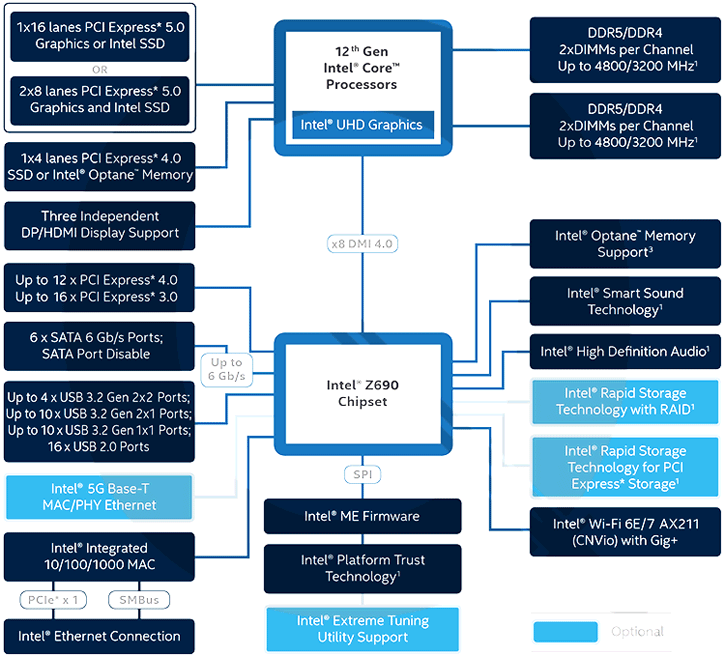
It was time for a new architecture, created from the ground up with a hybrid design; meet Alder Lake, which you’ve probably already heard a lot about. They will also be the first to adopt a hybrid architecture, similar to ARM’s BIG.little, that combines high-performance cores combined with efficient ones, making them the first of their kind for Intel. Furthermore, this new generation is now proven to be the first to support DDR5 memory (DDR4 compatible memory controllers as well) and PCI-Express 5.0, making it the first generation to do so.
Mind you the Core i5 12400 has 6 physical cores but 12 threads. 6 P-Core (12 threads) but 0 E-Core. The CPU has 18 MB L3 cache. That’s 6 P-Cores for 20 MB L3 in total.
9.5MB (6x 1.25MB)
L3 cache 18MB
Solely performance cores
Alder Lake will make use of Golden Cove CPU cores when speed and performance is critical. And these should make a significant difference in IPC when it comes to processing data compared to say Comet- and Rocket lake. Golden Cove CPU microarchitecture will take the place of the Sunny Cove, Willow Cove, and Cypress Cove microarchitectures, according to Intel. Originally described to as 10 nm Enhanced SuperFin, it will be made using Intel’s Intel 7 manufacturing node, which was introduced in 2012. (10ESF). These high-performance cores will find their way into scalable processors such as Alder Lake and Xeon, as well as Sapphire Rapids. According to Intel, all of the enhancements combined should result in an improvement in IPC of 19 percent, which is on par with or slightly higher than the improvement achieved by Sunny Cove when compared to Skylake. That should even be sufficient to dethrone the Zen 3 architecture of the Ryzen 5000 CPUs.
64KB per core Level 1 instruction cache
DDR5 memory
PCIe 5.0 support
Support for AVX, AVX2, and AVX-VNNI instructions
Below an overview of the new additions non-K processors.