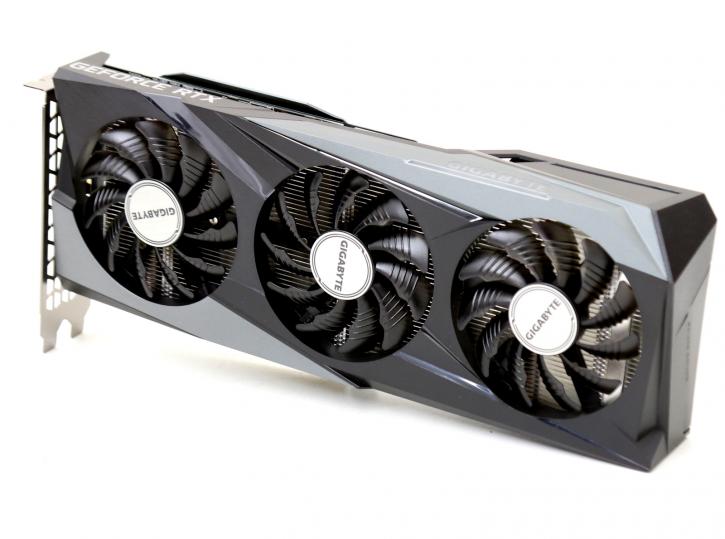
Gigabyte RTX 3050 Gaming OC review Introduction
Gigabyte RTX 3050 Gaming OC review Introduction
The GeForce RTX 3050 is NVIDIA’s newest entry-level to mainstream performance graphics card series in the company’s 3000 Series lineup. Disobedient to AMD’s dramatic 200 USD Radeon RX 6500 XT with 4GB/64-bit graphics memory, 1024 shader processors tied to x4 PCIe lanes; the GeForce RTX 3050 is 50 bucks more expensive (MSRP) based on 8GB/128-bit and 2560 shader processors utilizing x8 PCIe lanes. basically we’re looking at 1650 Series performance, but with added Raytrracing options and DLSS. The math immediately becomes visible, NVIDIA will win significantly today. With that 2560 shading cores and Ampere architecture, this 3050 series is bound to impress in the 1920×1080 and maybe even 2560×1440 (WQHD) domain. If stock becomes available in plentiful volumes though, as pricing will be everything. The GPU is again fabricated on an 8nm node derived from Samsung. This process further develops Samsung’s 10nm process; no EUV is applied in production just yet. Notable is that a change is in effect, the memory runs at 14 Gbps and finally, entry-level receives 8GB GDDR6. The Ampere lineup nearly doubles ray-tracing performance with Gen2 ray-tracing cores and 3rd iteration Tensor cores. These cards will all be PCIe 4.0 interface compatible and offer HDMI 2.1 and DisplayPort 1.4a, but most importantly is that nicer shader processor count (referred to as CUDA cores by NVIDIA). We now meet the NVIDIA GA106 GPU. And despite being a lower segmented card, it still holds a sizable GPU die. In this round, NVIDIA is not seeding Founder edition cards, aka FE GeForce RTX 3050. But of course, they do present the reference specification; a boost clock of 1777 MHz and a base clock of 1552 MHz.
Gigabyte unveiled its Gaming OC variant. Being cost-effective they scrapped the BIOS thus there’s no dual BIOS It has a somewhat more powerful power limiter available though as well as a three-spinner fan cooler similar to the classic Windforce X3. Based on the NVIDIA GA106 LHR GPU, this time in a more limited configuration; it features a shader core count of 2560 and 8GB GDDR6 graphics memory running at 128-bit and 14 Gbps. The card is powered by a single (6+2) pin header. Armed with a BIOS that supports a Turbo clock speed of 1822 MHz (1777MHz = reference) under the default BIOS setting. This card manages to generate 38 Dba noise levels only so expect decent acoustics. We rate the card as having a normal draw of ~130 Watts. We tested the factory tweaked model, it overclocks well, and is slightly faster than the founder edition requirements for the base model.
With 8 GB of GDDR6 RAM and 14 Gbps (effective data rate), the GeForce RTX 3050 is not far away from previous-generation models in terms of performance. A 128-bit bus connects all of this memory together. DisplayPort 1.2 is supported by the RTX series GPUs as well as the RTX 3050, 3060 and 3060 Ti series. The HDMI 2.1 connector supports 8K 60 Hz HDR using the HDMI interface. The card is around 1kg in weight. It’s also a rather small design, measuring only 29 centimeters in length. Because it is a dual-slot card, it will fit perfectly. The backplate is also open on both sides and reveals a small PCB. The looks are as expected, a little bland perhaps compared to the Aorus series. But that does show in price.