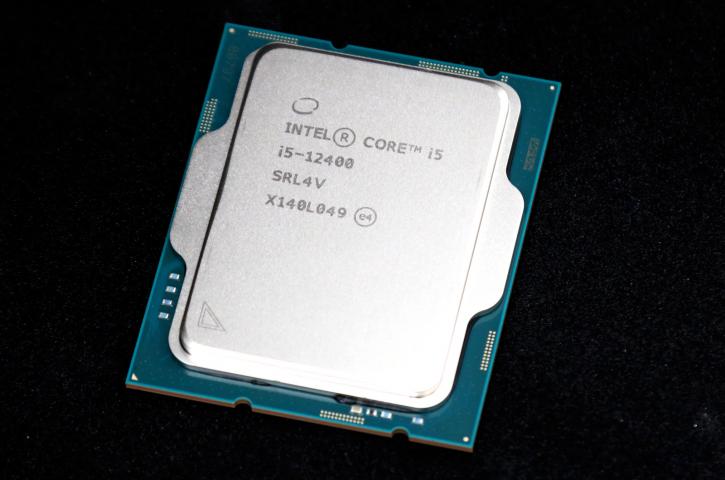
Core i5 12400 processor review Introduction
Core i5 12400 processor review Introduction
With six performance cores and hyper-threading, meet the Core i5 12400, what could be the most sought-after budget-friendly and rightly performing Alder Lake series CPU for use on a gaming platform today. It provides a significant amount of tier1 performance, can be tied to DDR5 memory when paired on the less expensive B660 chipset. Six high-performance cores properly clocked will offer you truthfully good gaming value, as well as excellent overall desktop performance for this processor, tagged at give or take 210 USD.
With this release, we enter the mainstream value segment, which means there’s no K-version (overclockable) of the processor as reviewed today. The Core i5 12400 will come in a 12400 and 12400F revision, the latter one has its IGP disabled. Every chip still has 16 PCIe 5.0 lanes, which can be used for either graphics or storage, though it should be noted that there are presently no B660 devices that implement the 5.0 specification. However, using a 200 USD proc on an expensive Z690 motherboard might not be the wisest thing to do, we advise you to seek that value B660 motherboard. Here you’ll end up at PCIe 4.0 lanes as opposed to PCIe 5.0 (not a big deal really). Motherboards will support either DDR4 or DDR5 memory, with native speeds of 3,200MHz or 4,800MHz, respectively, depending on the model. The Intel Core i5-12400 contains six Golden Cove P cores only, with hyperthreading. There are no energy-efficient E-cores active in this Alder Lake variant. The processor features an 18MB L3 cache and has a lower 65W TDP. On a single-core, the boost clock reaches 4.4GHz; on all cores that value is 4.0GHz with a base frequency of 2.5 GHz. This processor has a 65W base power (PL1) and a maximum turbo power of 117W (PL2). We have a lot to talk about and to explain; let’s had on over into the article, where we’ll start off with a bit more information bout the architecture that is Alder lake, the initial processors released, and of course, a full test of the processor. This article covers the Core i5 12400, a mainstream yet very gaming-friendly processor.
Alder Lake – Hybrid Computing Architecture
It was time for a new architecture, created from the ground up with a hybrid design; meet Alder Lake, which you’ve probably already heard a lot about. They will also be the first to adopt a hybrid architecture, similar to ARM’s BIG.little, that combines high-performance cores combined with efficient ones, making them the first of their kind for Intel. Furthermore, this new generation is now proven to be the first to support DDR5 memory (DDR4 compatible memory controllers as well) and PCI-Express 5.0, making it the first generation to do so.
Mind you the Core i5 12400 has 6 physical cores but 12 threads. 6 P-Core (12 threads) but 0 E-Core. The CPU has 18 MB L3 cache. That’s 6 P-Cores for 20 MB L3 in total. There are no energy cores present.
Performance cores exclusively
Alder Lake will make use of Golden Cove CPU cores when speed and performance is critical. And these should make a significant difference in IPC when it comes to processing data compared to say Comet- and Rocket lake. Golden Cove CPU microarchitecture will take the place of the Sunny Cove, Willow Cove, and Cypress Cove microarchitectures, according to Intel. Originally described as 10 nm Enhanced SuperFin, it will be made using Intel’s Intel 7 manufacturing node, which was introduced in 2012. (10ESF). These high-performance cores will find their way into scalable processors such as Alder Lake and Xeon, as well as Sapphire Rapids. According to Intel, all of the enhancements combined should result in an improvement in IPC of 19 percent, which is on par with or slightly higher than the improvement achieved by Sunny Cove when compared to Skylake. That should even be sufficient to dethrone the Zen 3 architecture of the Ryzen 5000 CPUs.
64KB per core Level 1 instruction cache
DDR5 memory
PCIe 5.0 support
Support for AVX, AVX2, and AVX-VNNI instructions
Below an overview of the new additions non-K processors.