ASUS TUF Z590-Plus WIFI review Introduction
ASUS TUF Z590-Plus WIFI review Introduction
We peek at the TUF Z590-Plus WIFI motherboard from ASUS, a socket LGA1200 and Z590 chipset-based product that offers a modernized infrastructure for your Comet Lake (10th gen) or Rocket Lake (11th gen) Intel processor, at the cost of € 229,- we’ll pair the unit with a Core i9-11900K bringing additional performance and PCIe Gen 4.0 to the platform as well. The CPU is fed by a 4 and 8-pin connector and for VRM design this motherboard as such has 16 phases backed by 50A power stages. ASUS applies a familiar dark shielded design.
The 11th generation into Core desktop processors is running up to 8 cores, which’s two down from 10th generation processors. Likely Intel needed the transistor space on 14nm for the increase in IPC, bigger Tier1 and 2 caches, and of course the new Xe-based integrated graphics solution. The processor socket sticks towards 1200 pins, aka LGA1200. After a BIOS update, Z490 will also be compatible with 11th Gen processors, be sure to check out compatibility with your motherboard manufacturers though. Among the main features we have HyperThreading through the entire line of Core products, so that’s from Core i3 to Core i9, up to 8 cores and 16threads, and up to 5.3GHz for a single-core boost if your cooling allows the processor to do so. The new Z590 motherboards will last for Comet Lake-S (last gen) and Rocket Lake-S (11th-gen). Being Z590, if you pair the mobo with a Gen 11 (Rocket Lake-S) processor, you’ll get 16 lanes of Gen 4 for graphics cards, and 4 lane gen4 available for a nice fast NVMe SSD. It also has and has nice cooled M2 slots, four of them! (only one can be used at PCIe Gen 4. Z590 allows USB 3.2 Gen 2×2 from the chipset. The USB 3.2 Gen 2×2 standard offers speeds of up to 20 Gb/s. Also, the new Z590 has native support for 3200 MHz DDR4 memory, but the OC model can run upwards to 5333 MHz with a compatible memory kit.
ROGZ590-Plus WIFI can accommodate up to three NVMe storage devices (2x Gen 3.0 1x Gen 4.0), cooled with heatsinks. This board features an Intel WiFi 6 adapter and two Ethernet 2.5 GigE LAN ports, unfortunately, that’s down from 5 GigE from the Z490 model. The dark-looking and themed motherboard can be customized LEDs wise with Aura Sync and the onboard Gen 2 addressable RGB LED headers. ASUS once again applies that familiar dark shielded design, optimized for cooling and armed with a proper feature set to build around 16 virtual stages. The motherboard offers your typical x16 PCI-Express slots (with Rocket lake x16 Gen 4.0 lanes are supported), extensive rear IO, and power LED configurable options. ASUS kept some stuff relatively simple, the 7.1 Realtek 1200S codec is used as well as WIFI6 (not WIFI6E) in the form of AX is available (WLAN 802.11a/b/g/n/ac/ax, 2×2, Intel AX201), also Bluetooth 5.2 is onboard. The board as stated is positioned in a mainstream priced segment, it does look very TUF-styled. Have a peek, and then let’s head onwards into the review my man.
11th Generation Core series processors (RKL)
Intel has been unfolding the new series with an up-to 8-core and thus 16-threads processor (2 cores down from last-gen) in the desktop processor segment (HEDT seems dead). Intel markets this series as its Core processor series whereas HEDT would have been tagged Core-X. More recently it has been adding the denominator the Core i9 series into that desktop lineup. Rocket Lake-S-based processors need to be paired with the Z490 series chipset (after compatible BIOS upgrade) or the new Z590 chipset for motherboards, as it has processor socket LGA1200. The top of the line processor is the Core i9-11900K with 8 cores and 16 processing threads (SMT). Its Base / Turbo frequency is 3.5 GHz and it can run upwards to 5.3 GHz on a core or two with what is called a velocity boost. It has 16 MB of L3 cache (down from 20MB), 20 PCI-Express 4.0 lines on the CPU, DDR4 @ 3200 MHz Dual-Channel memory configuration support, and a 125W TDP.
TB2 – Intel Turbo Boost Technology 2.0: Dynamically increases the processor frequency up to 4.9 GHz when applications demand more performance. Speed when you need it, energy efficiency when you don’t.
TB3 – Intel Turbo Boost Max Technology 3.0: Identifies the four best-performing cores to provide increased single- and dual-core performance up to 5.2 GHz, quad-core performance up to 5.1 GHz.
Velocity Boost
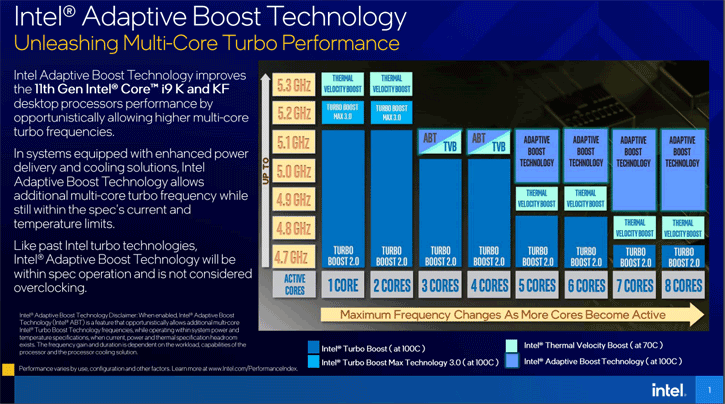
Adaptive Boost
Velocity Boost
Intel offers a third classification for its highest boosting frequency, this is called ‘Thermal Velocity Boost’. This is an extra boost of 100 MHz, on both the single and all-core turbo, however, it is only active under certain conditions. The conditions, as you can tell by its name, are the temperature of the processor, which needs to remain below 70 degrees Celsius. Once the processor gets warmer than this value, you’d revert to base or lower frequencies. This technology was introduced with Cascade Lake-X and is available towards mainstream desktop to ensure single-threaded tasks run on the fastest cores. Pretty much end-users with liquid cooling will benefit from this the most.
Adaptive Boost
Two weeks prior to release, another boost mode got introduced, which has been finding its way into BIOSes one week prior to reviews. The 11th Gen Core series codenamed “Rocket Lake-S” will get a 4th Boost mode, labeled Adaptive Boost. Both Thermal Velocity Boost (TVB) and Adaptive Boost Technology (ABT) will be exclusive to Rocket Lake’s Core i9-11900K(F) series. Adaptive Boost will only be available for the Core i9 K and -KF models: In other words, only Core i9-11900K and Core i9-11900KF. With a processor temperature of less than 70°C, it achieves a Thermal Velocity Boost of 5.3 GHz on two cores. That’s 5.2 GHz without TVB. If more than two cores are working, a maximum of 5.1 GHz is possible, but only for up to four cores if TVB activates. So four cores max. Adaptive Boost now takes it up a notch, if a proper power supply is applied, and if temps remain below 70 Degrees C, all eight cores can boost to 5.1 GHz. So for more than four cores the up to 5.1 GHz far exceeds the previous specification of 4.9 or 4.8 GHz. You’ll need the latest BIOS revisions to get this supported. You can see where this new Boost feature would help, multi-threaded apps and games.