Radeon RX 6500 XT review Introduction
Radeon RX 6500 XT review Introduction
The release of the Radeon RX 6500 XT is now official and the graphics cards are available. The item was originally listed at 199 dollars / 215 EUR, but at street price fetching close to $250-300. Never in history has entry-level performance been more costly. These cards are fitted with merely 4GB graphics memory, based on a 64-bit wide bus and a sniff of Inifinity Cache (16MB L3). Tied towards a PCIe Gen x4 link (3.0/4.0) this card performs at RX 570/580 performance levels as long as you stick to Full HD. The card are thus positioned as a max 1920×1080 offering and will include a GPU based on NAVI24. The Navi 24 GPU-based graphics cards are manufactured on a 6nm process and have a maximum of 4 GB of gddr6 memory and yeah; are connected through a very restricted 64-bit memory interface. The 4 GB GDDR6 RAM is buffered by a small 16 MB Infinity Cache though. The series card is projected to perform at the performance marker of the RX 570 XT (Polaris) and GeForce GTX 1060. The RX 6500 XT features 1024 stream processors. Numerous board partners have stated their own variants and setups of the card. We’ve mapped the major specs below to help you see what to expect.
NAVI24
The Navi GPU 24 is manufactured using TSMC’s 6 nm process, just as rumors had suggested. The Navi 24 chip should be the last of this generation’s chipsets. While doing so, the chip also serves as AMD’s first consumer product to be manufactured on a node smaller than 7 nanometers. Navi 24 has a chip area of approximately 107 square millimeters, which is sufficient room for “up to 16” compute units to be turned on at the same time. This would result in a total of 1024 computational cores or shader processors. Compared to the size of Navi 23, which powers the Radeon RX 6600 cards, Navi 24 is roughly half the size of Navi 23. For their part, the Navi 24 video cards should be viewed as an inexpensive way to get started with AMD’s RDNA2 graphics architecture, however as stated, the asking price is 199 USD, with the market indication 300 USD. A 16 MB Infinity Cache, as well as up to 4 GB of GDDR6 RAM, will be available on a 64-bit memory bus. Thus, the GPU concentrates its efforts on low-cost PCs and games in 1080p resolution.
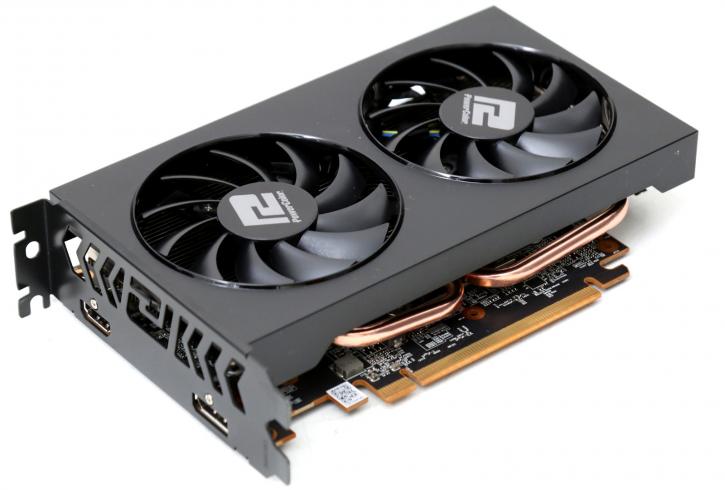
In this particular review, we’ll look at the Fighter model from Powercolor. However the reference the RX 6500 XT is a two-slot card with a full-height design. This card has a half-height, single-slot design and a single fan, which is similar to the also announced RX 6400. The cards contain a single DisplayPort and HDMI port.
Any Radeon RX 6500 XT will be equipped with 4 Gigabytes of GDDR6 memory, it will be connected to a 64-bit wide memory bus, which is a severe limitation for a graphics card of this series. AMD is attempting to compensate for the limited memory bus by running that memory at 16 Gbps (effective data rate) and by incorporating an additional L3 cache on the GPU die (on-die) (16MB). When it comes to Full HD and WQHD resolutions, both will assist you; however, once the L3 cache is depleted and VRAM runs out, which will occur mostly in GPU-bound situations, you can expect to see a huge performance hit.
In this class, the Fighter from PowerColor is considerably simpler to use as an entry-level graphics card than it is with a high-end one, and so only partially lives up to a premium designation. It has two fans and remains silent though. Our card has stock clocked frequencies, so you’re looking at reference performance.
With the exception of the shorter length, the cooler’s design is remarkably similar to that of the larger branch. The Radeon RX 6500 XT Gaming X has only one 6-pin power connector, even when overclocked. The cooler must dissipate the official ~120 watt TGP (GPU + memory) and 150-watt TBP (complete graphics card) That 6-pin PCIe connector indicates it has a maximum power of 150 watts, which is in line with the specs. The cards all get HDMI 2.1 connector and the latest iteration in DisplayPort. Most cards will hold a 6 or 8-pin headers configuration depending on AIC/AIB choices as partner cards are free to choose to use whatever they deem applicable.
